It’s been about a year since President Donald Trump signed the One Big Beautiful Bill Act (OBBBA) into law, drastically cutting federal support for the solar industry.
The move immediately made ITC and PTC incentives harder for solar developers and EPCs to access. It also shortened the timeline for projects to qualify for them, and sunset deadlines and tax incentive timeframes.
While the initial shock left the industry reeling (especially residential solar installers), overall solar growth has been resilient. The rules are different, but savvy solar companies are rolling with the punches.
However, losing federal tax incentives highlights a glaring issue: projects just became more expensive. With that fact in mind, developers and EPCs need to control costs while maintaining quality standards.
Creative Cost-Cutting
Fewer tax credits and incentives are available, but solar EPCs can still maintain a positive internal rate of return (IRR).
IRR measures the profitability of a proposed solar site over the span of its usable lifetime, and includes factors like:
- The project’s initial cost
- Operations and Maintenance expenses
- Potential and realized cash savings (rebates, electricity sales/savings, and other benefits)
- The project’s usable lifespan – typically 25-30 years
With so many variables, developers can pull levers in one area to compensate for issues in another, offsetting or improving the overall IRR. In this case, as rebates and tax credits eventually dry up, we can lower costs and improve maintenance by maximizing labor.
Why Is Labor the Next Cost-Saving Measure?
We’ve seen firsthand how quickly the solar development landscape can change – for better or worse.
According to the National Renewable Energy Laboratory (NREL), solar power’s levelized cost of energy (LCOE) has plummeted since 2010. Over the last 15 years, costs fell roughly 86% for utility-scale solar systems and 84% for commercial installations. The agency noted that prices fell quickly for several reasons, including lower system costs, better technology, and improved operations.
But while hard costs plunged, soft costs like labor, permitting, and taxes have been more stubborn.
For years, solar companies fought to hire as many employees as possible to support a rapidly growing industry. Today, the goal has evolved from having large staffs to efficient ones.
In 2026, the goal for EPCs and developers is to maximize productivity and minimize overhead. Since hard costs can’t fall much lower, the next option is to reduce labor costs. For many builders, it means finding ways to standardize builds, automate systems, and modularize components.
Reducing Solar Labor Costs
Since solar companies can’t do much to reduce the cost of permitting, fees, and taxes, reducing labor costs is the next best option.
To save on labor, we can either reduce overall headcount or improve productivity. Since reducing headcount is a drastic measure, optimizing installs is often a better long-term solution.
But what can developers do to maintain operations while preserving bottom lines and IRR?
Automate Installations When Possible
Automation has been a lifesaver for many industries, as robots perform repetitive tasks, while allowing people to do higher-value work.
Robots, artificial intelligence, and drones have many applications in the field, both physically and virtually. For example, robots can use GPS tracking to precisely dig pilot holes or move and install heavy racking. They can also precisely install panels onto racks, all under a worker’s watchful eye.
With an unmatched blend of speed, accuracy, and dependability, automated robots and other high-tech gadgets are taking solar by storm. Companies like Terabase say their bots can automate construction, cutting costs and freeing workers for other tasks. Not only does the system double productivity, but Terabase says Terafab® work is safer and of better quality, too.
Terabase is only one automation company, but it’s part of a burgeoning robotics industry. As the technology improves and automated system costs stabilize, expect adoption to rise dramatically.
Lean on AI Mapping
Artificial intelligence is a white-hot topic, so it’s no shock that solar companies have found ways to use it effectively.
One of the easiest ways to implement AI into solar projects is to assist engineers with site configurations. Today, a team of engineers may create, test, and review potential solar project layouts, which is time-consuming and costly.
With AI tools, solar engineers simply upload data and wait for the system to spit out results. Once the review is ready, the team checks its work to test the design’s feasibility.
In this case, solar companies need fewer engineers for each project, allowing them to spread out across more projects. This increases productivity and shortens timelines for solar projects across the entire portfolio.
Beyond site testing, AI is also helpful for creating digital twins of solar sites. Digital twins are exact virtual versions of physical objects or designs and help engineers spot potential problems before breaking ground. These replicas mimic planned sites, giving teams visibility into what the final project might look like and how to improve it.
AI is expanding quickly, but even supercomputers get answers wrong sometimes. Project engineers should ensure the data fed to the system is accurate and double-check every output. However, if everything checks out, artificial intelligence can improve performance and mitigate fail points during development and operation.
Pre-Fab and Modular Solar Materials
When time is money, the easiest way to reduce labor costs is to shorten timelines.
One way to accomplish both goals safely is to reduce the amount of boots-on-the-ground time workers spend assembling solar installations. Luckily, you can modularize most parts of a utility-scale solar site, including foundations, racking, and even PV wire.
PV Wire
PV wire is a small part of the overall solar project cost, but plays an oversized role in the project’s performance.
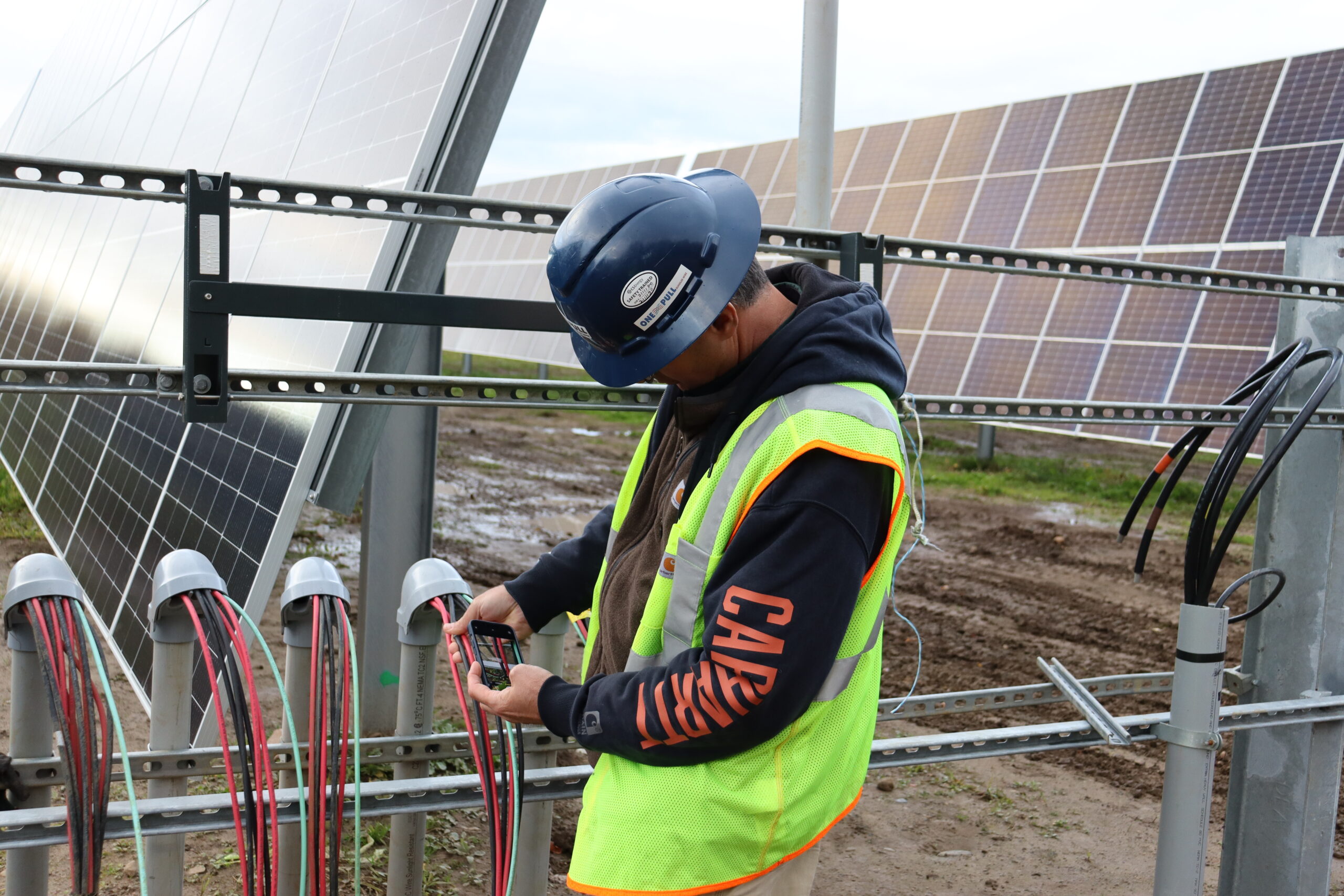
When workers field-install PV wire connectors, it slows them down and may lead to potential mistakes. These mistakes can result in loose fittings, reduced performance, and even arcs, sparks, and fires.
Pre-fab PV wire eliminates a critical fail point during installation. Manufacturers can bundle and fit PV wire with pre-tested, uniform connectors for fast field installation. Ultimately, pre-fitted connectors and bundled wire reduce installation times and increase project quality.
Racking
Racking is a durable, weather-resistant framework that holds PV panels in place. Depending on the need, crews can install fixed-tilt or single/double-axis racking to maximize energy generation.
Like PV wire, workers can build racking systems off-site, then deliver them to the jobsite for installation. Developers can also attach pre-fab racking to modular foundations or ground-mount systems to further streamline processes.
For developers, pre-fab racking takes additional risk out of the project. First, workers don’t have to worry about weather delays slowing them down as they weld pieces together. Secondly, critical welds and other delicate fabrication work are happening off-site, ensuring every weld passes inspection.
Lastly, because these systems install more easily, solar EPCs can use less experienced labor and still maintain speedy production.
eBOS, Simplified
In 2026, simplicity and speed are paramount. Thankfully, companies have no shortage of modularized parts.
Modularization helps developers move quickly to bring sites online while saving time, labor, and headaches. But beyond making initial set-up a breeze, pre-fab parts come in handy during maintenance as well, reducing downtime when something needs replacing.
So, which eBOS parts have pre-fab options available?
- Combiner boxes with customized string configurations
- Wire harnesses, clips, and brackets to hold PV wire in place
- Factory-molded and installed field connectors for safe, secure connections
- Factory-made concrete ballasts reduce weather-related risks and debris affecting concrete integrity
In each case, pre-fab parts keep as much work off-site as possible. When done well, developers need fewer workers to do more work while maintaining safety. Plug-and-play pre-fab parts and pieces later reduce downtime and maintenance costs by being easy to install and replace.
More Focus on Standardization
Standardization, as the name implies, strives for similarity.
The idea behind standardization is that it creates familiarity over time. Once workers understand how to work with the assigned parts and pieces, they can quickly and confidently perform work across any site using those parts.
And, like modular parts, standardization creates simplicity. Complex installations require more expensive workers, more time learning new systems, and longer development timelines. When developers can simplify the process and components used at each location, workers can get more done each day.
Long story short, simple saves time, money, and effort without sacrificing quality and reliability.
Working With the Landscape
Sometimes, investing in the right spot to build is the easiest way to save time and labor costs.
Usually, this means looking for stable locations where the ground requires little prep work. Excavating, moving and grading land, and adding infrastructure takes significant time and cost.
To reduce labor costs, we can start by finding easier locations to build on. Brownfields like landfills, coal mines, and other locations, sometimes already have infrastructure from previous uses. From roads and substations to other land development, these sites can supercharge solar project timelines. Pre-established substations also make it much easier for solar sites to interconnect to the grid later.
Companies can also look for locations where digging and grading may not be necessary. Crews can avoid excess work by using pre-fab foundations or ballasts, or by using racking systems that work with steeper slopes. In both cases, crews can remove a step or two from the preparation process, cutting crucial time from the timeline.
Controlling Labor Costs is Possible
Despite declining federal support and financial incentives for large-scale solar development, solar energy companies still have wiggle room.
Today’s economy is about doing more with what you have and prioritizing safe, efficient installs every time. With strategic investments in emerging technology and approaches grounded in simplicity, developers can reduce labor costs without losing quality.
The clean energy industry has the opportunity to embrace cutting-edge technologies, including artificial intelligence. AI is useful in many instances, from checking permits and creating digital twins to remote monitoring on completed sites. In each case, technology frees up engineers and workers to focus on higher-caliber tasks.
Additionally, robots can fill roles that recruiters couldn’t hire for. The solar industry still struggles to find talent, so supplementing teams with automated robotic solutions makes sense. Robots are fast, accurate, and meticulous; when supported by eagle-eyed workers in the field, projects move faster without forfeiting safety.
Keeping the Industry Moving
Ultimately, reducing labor costs for solar developers and EPCs provides massive benefits for companies and the industry.
More efficient labor improves the bottom line, streamlines project timelines, grows profit margins, and enhances scalability. And with so many large-scale U.S. initiatives, including data centers and electrification efforts, solar has no time to waste.