
Solar Success: Illinois Passes Clean and Reliable Grid Affordability Act

In January, Illinois Governor J.B. Pritzker signed the Clean and Reliable Grid Affordability Act (CRGA) into law, sending waves through the solar industry. 

The CRGA builds on the state’s successful 2021 Climate and Equitable Jobs Act (CEJA), cementing Illinois’ commitment to renewable energy. But, perhaps most importantly, the upcoming law could make electricity more affordable for residents. At a time when energy consumption is rapidly increasing, affordable electricity is a critical issue. 

But what does the CRGA do for Illinoisans, and can other states use it as a blueprint for their own residents? 

What is the Illinois Clean and Reliable Grid Affordability Act (SB-25)? 

According to Gov. Pritzker, the law, which takes effect June 1, 2026, achieves several key renewable energy goals. 

While the focus is on driving clean energy development, the CRGA aims to align ratepayers, developers, and utilities. When combined, proponents of the law say it could create jobs, lower electricity rates, and stabilize grid performance. 

Specifically, the CRGA tackles a few high-level issues, including: 

Lower Utility Bills for Illinois Residents 

As part of the law, Illinois plans to add another 3 GW of battery storage to the state’s grid by 2030. Battery storage has given solar and wind energy a boost in many instances, making them more consistent power generators. 

Another method of reducing utility bills is by adding more power generators to the grid. In this case, the state is lifting a decades-long moratorium on nuclear energy development. Keep in mind, the moratorium isn’t ending for all nuclear installations, just those over 300 MW. 

The CRGA includes another layer designed to reduce consumer costs. State utility and energy regulators have more power, giving them oversight into overall resource planning and management. The hope here is to reduce grid volatility and slow down or reverse energy costs. 

Develop New and Emerging Energy Sources 

For decades, traditional fossil fuels like coal, oil, and natural gas have ruled the generation landscape. 

Today’s electricity generation mix, however, is more diverse, thanks to innovative clean energy technologies. Illinois’ CRGA continues to promote new energy sources, allowing the state to develop new long-term renewable energy partnerships. 

But partnerships don’t mean much if residents don’t save money on their electricity bills. To reduce costs and encourage development, the CRGA expands the maximum size of community solar projects from 5 MW to 10 MW. By doubling the size, lawmakers hope to create more opportunities for mid-scale solar projects while improving grid reliability. 

Of course, embracing new technology means striking while the iron is hot. Although Illinois wants to establish a long-term approach to clean energy development, federal funding may not be available. To that end, the state has reduced red tape, fast-tracking renewable energy projects to beat federal tax credit deadlines. 

The move makes sense, considering the current administration’s stance on clean energy. The CRGA essentially allows Illinois to “get while the getting is good” and receive money before federal sunsets arrive. 

Protecting Consumers 

One aspect of the CRGA that appeals to many people is the establishment of a Solar Bill of Rights

Essentially, the Bill of Rights solidifies several key protections for residents, including those investing in low-voltage solar projects. 

According to the CRGA, “Notwithstanding any provision of this Code or other provision of law, the adoption of any ordinance or resolution or the exercise of any power by a county that prohibits or has the effect of prohibiting the installation of a solar energy system or low-voltage solar-powered devices is expressly prohibited.” 

Long story short, HOAs, municipal governments, and counties can’t stop residents from taking advantage of solar energy. This is a win for consumers, as it opens the door for anyone to generate solar energy. For example, renters could one day invest in ultra-small-scale systems to reduce costs. 

The CRGA also creates and expands Virtual Power Plant programs in the state for people with battery storage systems. According to the law, residents enrolled in a VPP can receive a $250 rebate per kWh of storage capacity. 

Create and Update Integrated Resource Plans 

One of the most critical pieces of the CRGA is the creation and expansion of Illinois’ Integrated Resource Plan. 

The idea behind IRPs is simple — save ratepayers money, maintain grid reliability, limit energy shortfalls, and improve energy portfolios. When done well, integrated resource plans put operators and ratepayers on equal ground. In this case, the state’s electric utilities must work in good faith to maintain ratepayer costs while planning for the future. 

Utilities must submit initial IRPs to the Illinois Commerce Commission by November 15, 2026. Subsequent plans are due on September 30, 2029, then again four years later. 

Cautiously High Hopes 

The CRGA is ambitious, but Illinois Power Agency officials say the law could save ratepayers $13.4 billion over two decades. All told, net savings could sit around $12 billion. 

Skeptics, though, think the estimated savings could be on the high side. They contend that battery subsidies may trigger additional costs, forcing consumer rate hikes. The jury is still out, but battery costs have fallen dramatically in only a few short years. 

Meanwhile, state officials say the CRGA can limit energy waste and provide much-needed relief for low-income residents. The Citizens Utility Board (CUB) echoed the response, suggesting $1 invested in energy efficiency could return $2 or more. 

But how does the math work? The CUB believes investments in the grid and alternative energies today could help the state avoid expensive future grid upgrades. 

How Does SB-25 Impact Illinois and State Sovereignty? 

The truth is, energy bills are rising, especially for low-income residents. 

The CRGA aims to improve affordability by increasing and diversifying the amount of power produced in the state. As more power comes online, costs go down, boosting affordability. 

At the same time, new and emerging energy generation options help modernize an aging electrical grid. The introduction of more solar systems, virtual power plants, and microgrids reduces reliance on the larger grid. Similarly, smaller grids and backup systems reduce the impact and spread of outages when they occur. 

Equally as important as keeping rates low is preparing for the state’s energy future. Combining solar, wind, energy storage, and even nuclear power plants helps reduce the need for fossil fuels. In turn, better technology enhances our ability to produce and distribute power. 

States Control Their Fates 

Illinois is among a growing number of states expanding their investment in clean, renewable energies. 

For example, Texas has heavily invested in renewable energy, becoming a leading solar and wind energy producer. The bet has paid off handsomely so far, as they’ve recently set generation records for solar and wind. 

ERCOT, which controls Texas’ electrical grid, recently reported new generation records, thanks to high winter wind speeds and sunny spring days. In 2025, the state also saw a large number of renewable projects come online, boosting overall production. 

As federal support for renewable energy fades, states like Illinois are spearheading state-led initiatives. Time will tell what these programs may look like in 5-10 years, but for now, they’ve given developers and utilities renewed hope. 

Will Other States Follow Suit? 

The solar industry can’t trust federal funding, which has sent a chill throughout the country. 

We’ve already seen the initial results stemming from the abrupt funding reductions for renewable energy. Tax incentives are ending sooner than expected, and Inflation Reduction Act programs have lost funding. In the current environment, states are now choosing to enact their own clean energy agendas. 

Luckily, solar developers and EPCs can access state and local government programs and find funding. The DSIRE database is especially helpful, compiling state and municipal programs designed to make renewable energy more affordable. 

Community and utility-scale solar developers can also find hope in community solar programs. Currently, 19 states and the District of Columbia have community solar programs, which establish microgrids and help consumers access low-cost renewable energy. 

A Blueprint for Other States 

Although Illinois’ new law isn’t active yet, in the coming months, the CRGA will give more teeth to the state’s previous 2021 law. It will also join many other progressive programs across the United States. 

The majority of U.S. states have some sort of clean energy portfolio, but many Southeastern states haven’t signed on. If successful, Illinois’ process could one day serve as a guide for other states with clean energy goals. 

We’ll eventually see how utilities, ratepayers, and the state will adjust, but renewable energy seems safe for now.
Has the Solar Industry Improved Under Inflation Reduction Act?

When President Biden signed the Inflation Reduction Act (IRA) into law on August 16, 2022, it opened the door for a clean energy renaissance. 

Since then, a flurry of activity has occurred, especially in the burgeoning solar industry. Many new manufacturers and solar installations are cropping up across the country, but has the IRA had the intended effect we thought it would? 

What Did the Inflation Reduction Act Do? 

From the get-go, the Inflation Reduction Act laid out several ambitious goals. 

  • Make solar adoption more affordable 
  • Increase domestic manufacturing 
  • Create solar jobs 

In theory, the IRA would deliver the best of both worlds. The IRA instituted billions of dollars in programs, tax incentives, and development projects to bolster renewable energy production. Manufacturers also lined up, investing billions of their own dollars, with government support, to reshore solar development and production. 

But beyond the basics, the IRA has given the industry and government several things to cheer about. 

Solar Costs Drop 

When the IRA took effect, the inflation rate was over 8%, making it harder for businesses to fund projects. Despite the high cost of borrowing, the Inflation Reduction Act enhanced and extended programs to make solar more affordable. 

Among them were a series of tax credits, including Investment Tax Credits (ITCs) and Production Tax Credits (PTCs). Solar EPCs can claim ITCs upfront based on system costs. PTCs, meanwhile, are based on the amount of electricity produced over the project’s first 10 years. 

Every project is different, but deciding which credit makes more sense depends on project size, power output, and eligibility. 

Other credits encourage investments in low-income areas, rural communities, and abandoned sites like brownfields. These projects create jobs in underserved communities, add formerly abandoned sites to the tax rolls, and improve access to low-cost electricity. 

At the same time, utility-scale solar costs have leveled out in recent years, according to the National Renewable Energy Laboratory. Other costs, including labor and permitting, have also been resilient.  

Meanwhile, several tax credits tied to prevailing wages and brownfield development have helped lower costs. 

Domestic Manufacturing Blossoms 

As part of the IRA, the Biden administration pushed for more domestic solar manufacturing. So far, the Inflation Reduction Act has done what it intended to do. 

The IRA introduced Advanced Manufacturing Production Tax Credits for solar energy, which ties incentives to producing renewable components. Also known as 45X MPTC, manufacturers receive the credit per unit produced and sold. Eligible products include solar photovoltaic (PV) modules, inverters, batteries, trackers, and critical minerals. 

Another tax credit helping manufacturers is the Advanced Energy Project Credit (48C ITC). Like the previously mentioned credit, this applies to manufacturers building or upgrading facilities. However, it incentivizes companies to outfit their buildings or facilities with greener installations. These installations must reduce greenhouse gas emissions by 20% through low- or zero-carbon heat systems. 

Although the two credits cover different aspects of solar energy, companies cannot take both. 

Spurring Investment 

Beyond tax credits, the IRA allows more public/private investments to produce renewables. 

According to the White House, companies have announced about $265 billion in clean energy projects since August 2022. Many of those projects are in areas living below the median household average, bringing high-paying jobs and low-cost energy to underserved communities. 

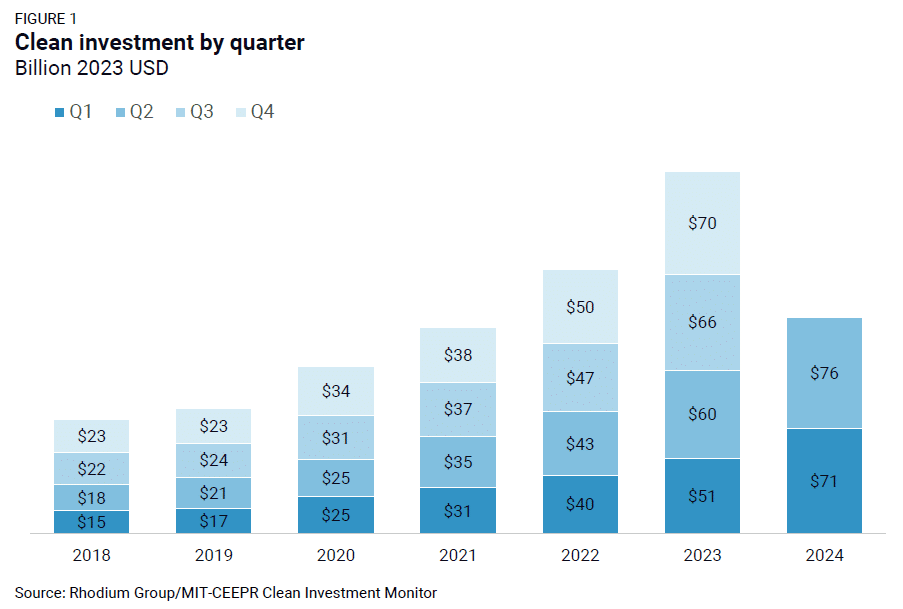
Other information from the Clean Investment Monitor tells a similar story. In the first half of 2024, companies invested $147B into clean energy manufacturing and deployment. The amount has increased dramatically each year since 2022 as companies find ways to incorporate renewables into manufacturing, energy production, and operations. 

From opening new manufacturing facilities to upgrading critical infrastructure, solar and other renewables are thriving under the IRA. 

Bringing Back Jobs 

One of the most attractive features of the IRA was its ability to create manufacturing and skilled labor jobs. 

Since August 2022, the IRA has helped launch 330,000 new clean energy jobs. Manufacturing jobs are also coming home as the U.S. attempts to wean itself from overseas solar panels from Asia. 

Facts and Figures: Assessing the IRA’s Impact 

One way to analyze how well the Inflation Reduction Act has performed so far is to look at the metrics. 

What have we seen over the past 24 months, and is it enough to call the law successful? 

Clean energy investments are taking off. Source: Clean Investment Monitor (Tallying the Two-Year Impact of the IRA (cleaninvestmentmonitor.org))

Renewable Investments are Way Up 

Clean energy investments totaled about $147 billion through June 2024. 

Though the number is impressive, it’s more exciting when compared to investment figures before the IRA. In 2021, clean energy only garnered about $141 billion for the entire year. Seeing the number eclipsed in half the time is wildly impressive. 

All told, clean energy projects have pulled nearly $500 billion in investments. Some of the most welcome growth came from the manufacturing and transportation technology industries, with $89 billion invested. The total was more than four times the amount in the two years leading up to the IRA. 

More Projects Coming Online 

Officials have announced hundreds of projects across at least 40 states, with many tied to solar, wind, electric vehicles (EVs), and battery storage. 

According to RMI Analysis, the government has only disbursed about $66 billion in funds through the first half of 2024. More projects will come online in the next few years, including an estimated 320 GW of clean energy projects. 

More importantly, as new manufacturers and clean energy projects launch, added jobs will become available. RMI expects the solar industry alone will need 500,000 workers by 2033, doubling the number of jobs available today. As a result, we need more educational and certification programs today to develop tomorrow’s workers. 

Better Grid Resilience 

What good is generating a ton of renewable energy if the current electrical grid can’t support it? 

The IRA has provided a lifeline for grid operators to improve the grid. As more green energy comes online, including wind farms and utility-scale solar power, the grid must support it. That means investing in efficient power plants and transmission and distribution lines to move electricity effectively. 

Grid resilience could take several forms. One choice is to add to the grid to help it accommodate more electricity. Expanding the grid is not popular, as substations and massive transmission lines cause problems for communities. 

Another possibility is to improve transmission lines with new conductors. Most conductors crisscrossing the United States are aluminum wrapped around a steel core. The conductor design is over a century old (the patent is from 1908), so minor improvements could go a long way. 

A third option is to add more microgrids. Microgrids are small community grids that can run independently. If a storm takes down the larger grid, a microgrid can disconnect to still provide power to homes and businesses. 

The goal is to equip rural communities with microgrids powered by renewables and energy storage. Residents get reliable, low-cost energy produced close to home, and utilities can use microgrids to quickly pinpoint and correct problems during an emergency. 

Because the grid is such a critical piece of infrastructure, the government is stepping up to help. Luckily, the IRA and Bipartisan Infrastructure Law combine to create the largest investment in the power grid’s history. The laws will upgrade and rebuild infrastructure to accommodate new technology, expand service, and increase resiliency. 

Not All Sunshine 

No legislation is perfect, and the Inflation Reduction Act has shortcomings. 

Though the law does a lot for the green energy community, there are several holes, including some outside its control. 

The Rules Can Be Murky 

No government initiative would be complete without endless confusing and difficult rules. 

Between understanding how to qualify for the ITC and PTCs, navigating community, county, state, and federal regulations, and chasing down funding, getting projects off the ground is slow. Worse yet, the ITC and PTC dollars are sometimes not easy to qualify for and will only get harder to reach in later years. 

Despite the occasional trouble, companies have invested billions of dollars into developing a vibrant solar energy industry. 

Interest Rates Are Still High 

The long-term solar industry is growing by leaps and bounds, but high interest rates temper some investments. 

High interest rates make projects, facilities, and infrastructure upgrades more expensive. Everything comes with an extra added cost, potentially leading to delays or cancellations for builds. 

High interest rates have also resulted in a sharper increase in solar LCOE compared to fossil fuels. Though solar is experiencing an uptick in cost, fossil fuels still have a higher LCOE, making solar and other renewables more cost-efficient over the long run. 

Additionally, anticipated rate cuts in the coming months may kickstart investments in other projects, keeping the good times rolling. Investments are booming dramatically under the IRA despite currently high interest rates. 

We Still Rely on Others for Panels 

In June 2022, the Biden administration issued a two-year moratorium on solar panels from four Asian countries to keep projects going while domestic manufacturers caught up. 

The temporary pause is over, and new tariffs have been added to overseas solar products.  

Why? To protect a bevy of new manufacturers in the U.S. Without tariffs, cheap solar panels could flood the U.S. market, driving domestic manufacturers out of business. 

While solar manufacturing is making headway in the U.S., the industry cannot compete with low-cost panels. Tariffs keep the playing field even until U.S. manufacturers can sufficiently meet demand. 

Despite the tariffs and occasionally frosty relationship with China, the United States relies on many solar products. China controls roughly 80% of the global solar supply, from raw material sourcing to finished goods. 

Prices could skyrocket if solar EPCs and other installers lose access to overseas solar panels. American-made products are high quality but come at a high cost – sometimes too high for a budget to absorb. 

Spiking prices could cripple U.S. solar expansion until the domestic manufacturing supply chain catches up. 

Looking to the Future 

All things considered, renewable energy is moving in the right direction. 

Domestic manufacturing is increasing, and public/private investments are pouring in. Under the IRA and other initiatives, the industry should reliably expand over the next decade. Costs are stable, the government has incentivized expansion and development, and consumers are saving money in the long run. 

Though the long-term prospects look good, the upcoming 2024 election could affect the future of renewables. Depending on who assumes office and what agendas are announced, portions of the IRA could be rolled back or scrapped entirely. 

Overall, the IRA has done its job. Solar and renewable investments are exploding, the industry is vibrant, and there is real hope for a carbon-neutral future.