Cost Efficiencies for Utility-Scale Balance of System

In recent years, utilityscale solar costs have been declining, with an 82% decline reported since 2010. However, this downward trend in solar costs has not been reflected in the cost of balance of system. With a lot of focus being placed on PV modules, little research has gone into exploring balance of system and the costs associated with it. This is changing however with an increase in knowledge of its cost reduction potential.  

Utility solar balance of system costs account for 68% of PV System pricing. These costs include soft and hard costs. The soft costs comprise installer costs such as labor and administrative costs as well as financing and contracting costs, system design and engineering expenses, and costs related to permitting and interconnection. Hard costs on the other hand entail costs associated with the physical components of the system. These costs are detailed further in this article. Knowledge of these costs not only allows project managers to control costs, but also increase efficiency  

When it comes to driving down the costs of a balance of system, there are three main areas of concern: material use, logistics, and installation times and requirements. Looking into material use, for example, most utility-scale solar systems are manufactured using steel. While aluminum is also an option, cost considerations generally steer developers away from it.  


Cost-saving solutions for a utility solar balance of system include but are not limited to: 

1. Planning ahead

Site access and preparation are important in any utilityscale solar project. This allows a contractor to determine every essential component of the project including installation time. Varying site environments and landscape call out for specific components which when left out could result in potential losses for project owners in replacing components down the line. Customized planning ensures not only a cost-effective system but also an energyefficient BOS environment.   


2. Estimating and comparing costs of different components

Balance of system components offered for solar projects differ in several aspects including costs. Planning not only allows determining necessary components of the project but also find alternative cheaper substitutes. Contractors can also implement cost-effective designs that do not compromise on the quality of the system. Picking the right components despite higher costs is essential to the longevity and performance of the system hence the cost of the project.   


3. Implementing turnkey solutions

Because work on a construction site is prone to weather and other delays, it is important to reduce installation times as much as possible. While this could be done by increasing the labor force of the project, this not only raises the cost but also brings about issues with over-resourcing. It is, therefore, best to implement turnkey or pre-assembled solutions meant to cut down installation time while maintaining the profitability of the project. One such solution is the use of a pre-bundled solar wire harness designed to meet the needs of solar projects ensuring quick turnarounds and increased profit margins. 


 4. Implementing low maintenance and seamless BOS operations 

Streamlining the operations process associated with BOS installation cuts down on unnecessary tasks within the project. These tasks increase project costs and reduce productivity. It is therefore essential to rely on experience to recommend low maintenance and seamless BOS operations. This also helps manage risks associated with the solar project such as considerations of site access and ground surface adjustments, material supply, vegetation control, and design of the installation. Having experienced contractors aware of these risks could limit potentially costly issues and delays during the construction and production phase of the project. A seamless BOS operation also creates good communication that allows for issues to be resolved in the early stages of the project without a high impact on the project cost. 


Learn more about ways to find cost-saving efficiencies in utility scale solar projects.  
 

Balance of System for Utility Scale Solar

Utility scale solar systems consist of more than just photovoltaic panels. Planning for utility scale solar projects requires knowledge of all the components necessary to create an operational general project. These components are referred to as a balance of system, often abbreviated as BOS.

Most often, a balance of system refers to the components, equipment, structures, and services needed for the project beyond the PV modules themselves. A balance of system, besides the workmanship in the plant, determines the quality, safety, and profitability of the solar project since BOS components make up 50-60% of solar costs. Therefore, BOS components have a significant impact on the project’s overall costs and long-term profitability.

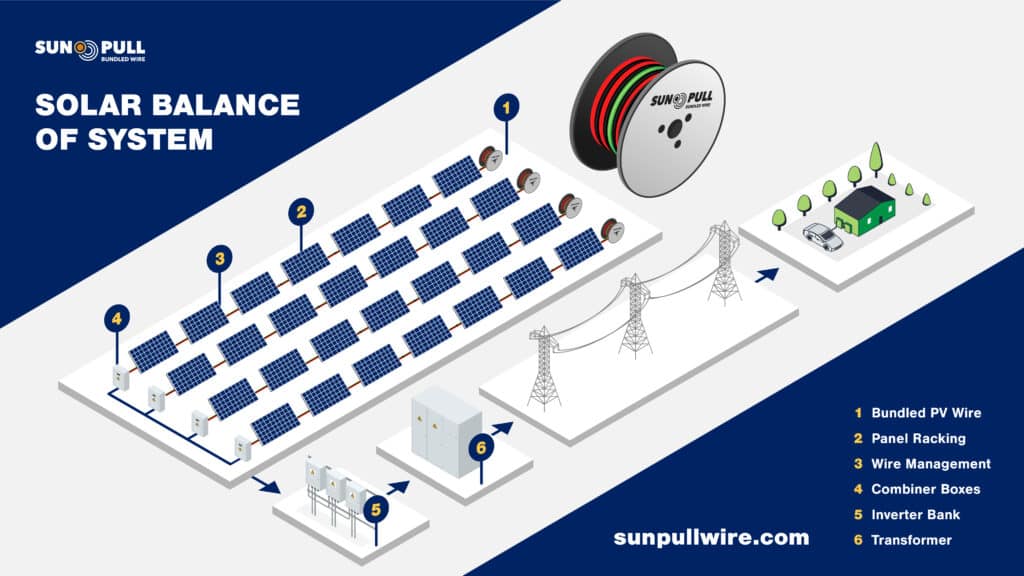
A solar PV balance of system is categorized into two groups: electrical and structural BOS. Here is a breakdown of these two categories and their applications in utility scale solar projects.

Sun-Pull Balance of System

1. Electrical BOS

To deliver the energy generated from the sun to the grid, electrical BOS components are needed to allow the current to pass through the circuit. There are multiple electrical BOS components that are vital for minimizing electrical system losses.

  • Inverters – inverters convert DC power produced by the solar array into usable AC power. These differ based on their costs, durability, and scale of the project. String inverters are more commonly used for utility-scale solar projects.
  • Wiring – in a PV installation, DC cables are required for connection between the PV components while AC cables are used to connect the inverter to the grid. It is essential to pick the right type of wiring for PV installations that can withstand the outdoor conditions. Implementing cost-saving wiring solutions can also increase the profitability of a utility scale solar project.
  • Combiner box – this combines multiple PV strings into a single circuit. Combiner boxes should be rated for outdoor applications and withstand extreme weather conditions.
  • Fuses & Circuit breakers – these are primarily used to protect the system in fault conditions. They also are used to protect devices from catching fire or from becoming more seriously damaged if there is a short circuit.
  • Grounding conductors – PV systems need to be grounded to protect people and equipment from electrical hazard and equipment damage. These include equipment grounding conductors (EGC), grounding electrode conductors (GEC), and rods. In special cases, PV systems need to be protected from lightning. That is also done through a special grounding electrode connected to the ground in order to drain the lightning current.
  • Conduits – conduits provide damage protection for conductors. Conductors are better protected if they are run through conduits, raceways, and wireways not only for damage protection but also safety precautions. All conductors between a combiner box and the utility disconnects are usually run through conduits.

2. Structural BOS

Installation requirements vary from one solar project to another. However, they all need systems designed to hold them in place. These are referred to as structural BOS.

  • Foundations – Solar panels require a strong, durable foundation. Foundation selection is critical for a cost-effective installation of PV solar panel support structures. There are four types of foundations commonly used such as driven piles, helical piles, earth screws, and ballasted foundations. The right foundation is based on the site conditions (such as the type of soil). Therefore, it is critical to thoroughly investigate the site of the project prior to picking the type of foundation.
  • Racking – Racking systems are a crucial element of solar arrays. To fix solar panels to the ground, solar installation companies use solar racking products, also known as solar mounting, to hold solar equipment in place in the installation. Just like solar foundations, racking systems need to be optimal for the site conditions. With proper installation, a sturdy racking system secures the PV solar panels in extremely harsh weather conditions.

Utility-scale solar project needs vary from one solar project to another. Knowledge of the project needs, and the BOS components required are crucial for the project’s profitability. This also helps determine which BOS components are optional and which ones are necessary, ensuring a cost-effective and energy-efficient BOS environment.

Check out innovative solutions to cut down on the overall installation cost of utility scale solar.

Bundled Wire Harness for Utility Scale Solar

As utility scale solar construction is projected to increase in 2021 and renewable energy becomes more widespread, there is need for more solar connectivity solutions and more specialized components to meet the unique needs of this rapidly evolving industry. One of these specialized components is a solar wire harness.  

A solar wire harness is pre-bundled solar wires designed to meet the needs of solar projects ensuring quick turnarounds and increased profit margins. 

We get a deep dive into the benefits of using solar wire harnesses from Tony Wagner, One-Pull’s Chief Operations Officer. 

1. Saves Project Time: Do in a Day What Traditionally Takes a Week

Pulling wire the traditional way with single conductors takes a long time. It involves a lot of labor, reel set up, and labeling. For PV wire installations on utility scale solar projects, this will typically involve 40 – 500 rows for projects between 5 and 25 MW. For example, installing solar PV string wire to power a 1-megawatt (MW) solar project might take a team of 3-5 electrical professionals one week to pull wire the traditional way versus one day when installing a pre-planned, pre-cut, and pre-printed bundled wire system. 

One-Pull custom prints the inverter/combiner box number and string number approximately every 12” on each conductor in the bundled cable harness. This allows for easy identification and eliminates the need to identify and label each wire saving the electrical contractors significant time. 


2. Increases Profit Margins

Switching from single PV string wire conductors to bundled wire harness enables electrical contractors to cut down on project time and get to their next project more quickly. Consequently, this increases their profit margins. 

The increased profit margins improve even more when including MC4 connectors preinstalled on the PV string conductors for easy connection to the solar modules, since the solar modules come with connectors pre-installed on the back of the panel. Every 1 MW requires approximately 180 connectors on the PV string end of the wire connections. These connectors are installed in advance only on one side of the harness to allow for the harness to be pulled through conduit. 

In addition to this, having pre-bundled solar PV wire delivered to the site means not having to store inventory on site. As a result, the bundled cable helps save on storage costs. 

Learn more about shrinking profit margins and other issues facing the electrical construction industry.  


3. Improves Chances to Win a Job Bid

One of the ways that electrical contractors can become competitive on job bids is by setting themselves apart from the competition. Using valueadded solutions such as a solar wire harness could ultimately help the electrical contractor win the job bid due to the competitive advantages that accrue from using a solar wire harness. A bid that stipulates a bundled wire solution makes the bid more attractive. 

Having a turnkey solution such as the pre-bundled solar wire harness assures projects stakeholders of the cost-savings and improved labor productivity, since such solutions provides proof that the project will be completed by the predetermined date (or potentially even faster). For electrical contractors, this means late fees are avoided.  

Find out other ways contractors can stay competitive on job bids.  


4. Eliminates Hazard and Safety Issues

Pulling single strings of wire on a utility scale solar project is strenuous and takes a physical toll on the workers. The more time electricians spend on the job site, the chance of incurring a job site injury inevitably increases. Electrical contractors are often looking for tools that enhance the safety of their teams on the job site. Using a solar bundled wire solution not only reduces the time they are exposed to weather conditions but also the time it takes to complete an installation. 

At One-pull, we deliver the bundled PV string wire on one reel per row or per conduit home run, ensuring faster pull times and less reels cluttering the job site that may lead to safety issues. One-Pull will also pick up the empty spools and pallets thereby eliminating further safety issues and disposal costs. 


Click to learn which states are creating solar opportunities for electrical contractors.  

Ways to Find Cost-Saving Efficiencies in Utility Scale Solar

The solar market in the U.S has been growing rapidly with a predicted installation capacity of 107 GWdc  in the next 5 years. Within this industry, utility scale solar continues to take up the largest share of annual installations. In Q1 2018 for example, utility photovoltaic installations accounted for 57% of the installed capacity. With this growth, comes an opportunity for suppliers and manufacturers that cater to EPCs and electrical contractors.

Solar installation prices can be expensive. Installation prices take into account both hard and soft costs. Here’s a quick overview of how these costs impact utility scale solar installations and innovative solutions to cut down on the overall installation cost.

Hard costs

These account for the hardware components of the solar installation. They range from solar panels as well as the balance of systems (BOS) components such as the solar mounting racks, PV string wire, fused cable harnesses, batteries, inverters, and combiner boxes. While these components are not cheap, their costs plummeted in Q1 2018 owing to weakened global demand and response to buyer pressures.

According to a cost breakdown of solar panels, the panels account for about 25-30% of the total system panel cost, not including the solar inverters, solar mounting, and BOS components. Here’s a pie graph showing the breakdown of hard costs.

Controlling for hardware costs can be challenging as there are many factors. For example, at the end of 2020, solar panel prices increased because of a shortage of glass and ethylene-vinyl acetate laminate.

There are also existing tariffs that continue to restrict the growth of solar in the United States. One restrictive tariff is Section 201 of the Trade Act of 1974. This tariff was meant to boost U.S manufacturing by locking out unfair competition from foreign countries. However, 98% of solar panels and their components are manufactured outside the United States. Therefore, this tariff and others not highlighted here have only slowed down the flow of lower-cost products from foreign countries leading to higher solar installation costs.

Soft Costs

Soft costs in solar installations refer to the non-hardware costs associated with the installations. Some of these include labor costs, payment for permits, and other overhead expenses associated with the system.

According to a breakdown of soft costs, they account for 64% of a new solar farm system’s cost making them vital in determining the cost of the entire system.

A large share of soft costs stems from labor which  makes up about 11% of the  total soft costs. Since labor costs tend to remain constant, they do not adjust quickly to market conditions.

Finding cost-saving efficiencies.

To make solar energy cost-competitive with other traditional forms of electricity, prices will need to continue to decrease.

Soft cost optimization will determine just how much costs can be reduced on a dollar-per-installed-watt basis and can yield more cost-per-watt benefits.

One innovative way to optimize the soft costs would be adopting solutions that reduce the 11% labor cost associated with installation expenses. Having a skilled workforce ensures a reduced labor gap in the industry. Educating the workforce and equipping them with the right training not only reduces this gap but also improves solar sales transactions, speeds up installations, and lowers expenses throughout the value chain.

Another way would be to implement cost-saving solutions such as using pre-planned, pre-cut, pre-labeled bundled cable in installations which can save up to 80% in the time it takes to pull the PV wire. For every 1MW of solar project installation, this equates to 3-5 people completing the string wire installation in one day vs. one week. Utility-scale solar components are expensive.Therefore incorporating components that are cost-savers ensures higher gross profit margins for EPCs.

Pre-bundled wire speeds up installations by cutting down on labor time and costs. By reducing time spent on pulling wire, electrical contractors can expedite the time it takes to complete a job and then move on to other projects more quickly.

While hard costs, such as solar panels as well as balance of systems (BOS) components, have been declining in recent years, soft costs have remained steady. Therefore, implementing cost-saving solutions will help lower the overall costs of utility scale solar installation projects.

Check out our time and motion study to learn how implementing bundled cable in industrial solar installations saves on labor costs.

5 Large US Solar Energy EPC Companies

5 Large US Solar Engineering, Procurement, and Construction Companies

The solar energy industry requires electrical contractors to grow and adapt right along with it. This short list shows how companies of all kinds are meeting the challenge – from California start-ups formed in 2008 specifically to address solar, to century-old New England companies introducing new solar energy departments.

Here are 5 of the largest US solar energy EPC companies.

1. Blattner Energy

Avon, MN
Founded: 1907
Total Kilowatts Installed: 4,448,870
Total Kilowatts Installed 2019: 1,069,110

Blattner Energy installed more kilowatts of solar energy than any other engineering, procurement and construction (EPC) company last year. If that’s not enough of an accolade, their recent growth is impressive. In 2019 they installed 24% of all the kilowatts they’ve ever installed. And they aren’t based in a famously sunny state, either. Blattner is in Minnesota, which is a testament to how Solar Energy PV technology is getting deeper into the mainstream and breaking free of outdated limitations.

2. CS Energy

Edison, NJ
Founded: 1906
Total Kilowatts Installed Since Founded: 767,490
Total Kilowatts Installed 2019: 233,230

CS Energy is an EPC, operations and maintenance (O&M), and energy storage company. Put simply, they really can do it all. They specialize in Optimized Projects, which are tailored to the size, energy production, and capital requirements of each individual project. Being able to provide totally customized solutions in the solar energy industry is critical in achieving the kind of growth CS Energy has.

And their commitment to their work, employees, and communities hasn’t gone unnoticed: In 2019 they won 3 Best Project Awards and were named the #1 solar energy EPC in MA, NJ and RI. Already in 2020 they’ve been named one of the Best Places to Work in New Jersey. Whether you’re looking for a solar energy EPC partner or a new company to work for, CS Energy has the portfolio and performance of an industry leader.

3. Swinerton Renewable Energy

San Francisco, CA
Founded: 2008
Total Kilowatts Installed Since Founded: 5,072,100
Total Kilowatts Installed 2019: 1,004,900

Swinerton Renewable Energy provides integration, engineering, procurement, construction (IEPC) services in solar energy PV and energy storage. They’re a subsidiary of Swinerton, which was founded in 1888, so needless to say they have the experience and leadership to maintain their growth in solar for another 150 years to come. If 2019 was any indication, growth won’t be a problem. The over 1 GW they installed last year was over 25% of all kilowatts installed. And they aren’t all business: the Swinerton Foundation has community-building projects all over the country.

4. Solar Energy Systems

New York, NY
Founded: 1998
Total Kilowatts Installed Since Founded: 62,479
Total Kilowatts Installed 2019: 11,417

Solar Energy Systems installed more kilowatts than any other New York solar energy EPC in 2019. Based in Brooklyn, Solar Energy Systems specializes in integrating commercial solar and electric systems, and they work throughout the Northeast. They may not have the highest number of installed kilowatts on this list, but they’re another inspiring example of how solar energy PV technology is succeeding in states not traditionally thought of as ideal for solar.

5. Black & Veatch

Overland Park, KS
Founded: 1915
Total Kilowatts Installed Since Founded: 1,296,093
Total Kilowatts Installed 2019: 515,833

Black & Veatch holds the spot of 4th highest kilowatts installed in 2019. This is far from their first success story: founded in 1915, Black & Veatch has been a best-in-class EPC for over a century (and they’re employee-owned). For most of that history they’ve focused on sustainable utilities and improving communities without leaving a negative impact. Just recently they launched a COVID-19 initiative to facilitate better contact tracing, testing, and screening through their experience with designing distributed infrastructures. This is the kind of innovative thinking that the solar energy industry is showing more leadership in, thanks to companies like Black & Veatch.

Learn how Bundled Cable helps EPC companies save time in installing wiring in even the largest solar farm installations.

Lessons from 3 States on Growing the Solar Energy Industry

Lessons from 3 States on Growing the Solar Energy Industry

South Carolina

Legislation and the Solar Industry Overcoming Disaster

In 2019, South Carolina passed the Energy Freedom Act. The driving theme with this legislation is “resiliency,” and they are taking it seriously. In 2017 and 2018 South Carolina was hit with hurricanes Irma and Florence, which left hundreds of thousands of people without power. Now the state has recognized that solar PV and solar power storage technologies are powerful defenses against future threats to their utilities infrastructure.

The Energy Freedom Act emphasizes “avoided costs and avoided outage costs,” which is a boon for solar energy contractors and the science of public utilities planning in general. This allows South Carolina’s Public Service Commission (PSC) to factor in projected potential costs of losing energy supply during an event like a hurricane. This also emphasizes solar energy storage, or “solar-plus-storage,” which is not yet common in solar energy legislation.

The legal issue of solar energy battery storage comes down to semantics. But the nuance is important and could set a precedent for other states. Before the Energy Freedom Act, net metering defined “customer generators” as “customer-owned or -leased systems that generate electricity from a renewable energy source”. As batteries don’t generate electricity, only store it, they were ineligible. The Energy Freedom Act updates this language to include solar and renewable energy battery storage technologies as eligible parts of a net metering system.

“Avoided outage costs” and “net metering” are not the sexiest or most interesting aspects of solar power. But it’s these details that will help the solar industry flourish, and South Carolina is truly leading the way.

Florida

The Solar Industry Overcoming Unfriendly Legislation

A seemingly obvious contender for solar energy projects, Florida has been slow to grow the industry. This is mainly due to legal roadblocks, specifically language that categorizes most solar energy companies as public utilities providers. This prevents them from selling directly to customers the way other states allow.

But Florida is adapting quickly and showing positive growth every year. In 2019, Florida had the second most solar energy jobs in the country with over 10,300 people working in the industry. This is an impressive 21% increase since 2017. Compare that to California, which has the most solar energy jobs in the country: they have decreased 11% since 2017.

How has Florida managed this growth? Cash. Florida offers some financial incentives for solar and clean energy, such as rebates for customers and net metering policies.

It’s frustrating that Florida has the third best geographic conditions for solar, but a government that’s slow to take advantage of it. But customers want solar and companies are doing everything they can to provide it, which is why Florida is also ranked third in the country for projected installed solar capacity over the next 5 years. If and when their laws catch up to their demand, you can expect that growth to boom.

Massachusetts

Legislation and the Solar Industry Overcoming Weather

There is an undeserved, but understandable, idea that cloudier states like Massachusetts can’t leverage solar as effectively as sunny states. But the costs of solar energy battery storage continue to fall and solar PV technology is advancing rapidly.

This is why legislation on avoided-outage costs and solar-plus-storage, like South Carolina has, is critical. And Massachusetts has some of the most generous net metering and solar energy storage incentives in the country. Their SMART program helps cover battery storage costs for lower-income households, which makes Massachusetts one of the easiest states to adopt solar energy as a consumer.

What These 3 States Tell Us

South Carolina is overcoming natural disasters. Florida’s solar industry is thriving despite an non-supportive government. And Massachusetts’ solar industry is growing despite being a low-sunshine state. What these three states tell us is that solar energy will continue growing no matter what. Between solar PV technology, public demand, legislation, and nature, solar energy will always have a champion.

Check out how our bundled cable saves electrical contractors on solar farm projects.

5 States Creating Solar Opportunities for Electrical Contractors

5 States Creating Solar Opportunities for Electrical Contractors

Adoption of solar photovoltaic (PV) and renewable energy storage technologies has been increasing exponentially over the past few years. In 2015 there were around 25,000 solar installations in the U.S. – today there are over 90,000. These 5 states are leading the way on solar with some of the best opportunities in solar PV  installations, job markets, and governance.

1) South Carolina

Last year, South Carolina passed the Energy Freedom Act to bolster the solar energy industry. This act emphasizes “avoided costs and avoided outage costs,” which allows South Carolina’s Public Service Commission (PSC) to factor in projected potential costs of losing energy supply during an event like a hurricane. The Energy Freedom Act also recognizes and incentivizes solar energy storage, or “solar-plus-storage,” which is still uncommon in solar energy legislation.

South Carolina is quickly becoming one of the best states for solar power projects, and there’s reason to believe it will stay that way for years to come.

2) Florida

Florida’s solar energy industry has picked up the pace in the past few years. In 2019, Florida had the second most solar energy jobs in the country, with over 10,300 people working in the industry. That’s an impressive 21% increase since just 2017.

If you look back on historical state data, Florida has lagged behind most peers when it comes to fostering solar energy. Now they’re ranked second in the country for projected installed solar capacity in the next 5 years. Even with legislation that is less generous than other states, Florida’s solar energy industry is growing. If and when these laws catch up to their peers like South Carolina, you can expect that growth to boom.

3) California

The solar energy installation sector in California accounts for 46,600 jobs, which is over 25% of the entire country. And a substantial portion of these jobs, over 28%, are non-residential and utility-scale projects. This means the highest demand in the country for solar PV and solar power storage materials and labor.

Unlike the other states on this list, solar energy jobs in California have decreased by 3.4% since 2019. This could be a potential sign of market saturation or waning government support. But it’s a safe bet that this lag will be short-lived. As new solar PV technologies emerge demand will increase, and existing technologies like batteries are becoming more widely accessible and recognized in legislation.

4) Arizona

Arizona has more sunny days per year than any other state. This has obvious benefits for solar-plus-storage PV technologies, but there are advantages to Arizona beyond the sun.

Even right at the borders of major cities like Phoenix there are miles of undeveloped land. For non-residential and utility-scale solar power installations especially, this is an advantage that most major cities can not provide.

In addition to the surplus of sun and land, Arizona has the second most solar energy manufacturing in the country. Unfortunately, adoption has been slow in the state due to net metering charges, disappearing incentives, and a less accepting public attitude towards solar energy in general.

5) Massachusetts

Northeastern states like Massachusetts often have the undeserved reputation that solar is less effective due to their cloudy weather. But especially with the prices of solar energy battery storage dropping, the need for constant sun is outdated.

Massachusetts has some of the most generous net metering and solar energy storage incentives in the country. This includes their SMART program, which helps cover the costs of battery storage for lower-income households, making this one of the adoption-friendliest states in the country.

Another benefit to Massachusetts is the number of science and technology universities and institutions. Utility-scale and infrastructure solar energy projects are often channeled through such technological organizations, and in Massachusetts those organizations are already well-networked with local government.

Check out how our bundled cable saves electrical contractors on solar farm projects.