Is the U.S. Ready for 100% Renewable Energy?

Renewable energy has grown by leaps and bounds in recent years. But is the U.S. fully prepared to move forward with a 100% clean energy program? 

In 2021, renewable energy produced about 20% of all utility-scale electricity in the U.S., but only about 2.8% (115B kWh) was supplied by utility-scale solar energy operations, not including the additional 49B kWh generated by smaller-scale solar operations. The number may seem small, but it’s been growing annually and gives people hope that a fully green grid may be possible. 

Two things are clear if you’ve followed the news over the past several years. Fossil fuels won’t be the answer forever, and renewables still have a couple hurdles to jump to pick up the slack. 

The U.S. has some pretty ambitious energy goals, and the Biden administration has hinted that it would like to take steps to move away from traditional fossil fuels. This includes an ambitious proposed plan to reach 100% clean electricity by 2035

Though some experts believe it’s possible to hit the goal in short order, more than 60% of our energy is dependent on fossil fuels. It will take more effort, investment, and support to achieve. 

Is the U.S. Ready to Take the Next Step? 

At first glance, it might sound like a loaded question – but the answer may be yes. 

Several high-level studies, including one by Stanford in 2015, believe the United States can ultimately run on renewable energy… just not by 2035. They peg the year at a more realistic and gradual 2050. Though the study has been questioned, inspiration can be taken from it and its methodology. 

This isn’t to say progress isn’t being made in certain states and regions toward a fully renewable future. Rhode Island recently signed legislation into law committing to 100% renewable energy by 2033. The move puts the tiny state at the forefront of the renewable revolution, and it could be the first in the nation to go fully renewable. 

Earlier this year, California also made headlines when the state was powered only by renewable energy. The conditions were perfect, allowing California to produce more energy than it needed using only renewable power. 

The Golden State has proven that renewable, carbon-free, and sustainable energy sources can replace traditional power generation methods like coal and natural gas. In 2019, about two-thirds of the state’s power came from renewable energy systems like wind, solar, hydro, and nuclear. According to one energy manager with the Union of Concerned Scientists (UCS), investing heavily in solar and wind technologies will get us the bulk of the way, up to 90 percent, toward our clean energy goals. 

Why It’s So Hard to Quit Fossil Fuels 

If renewables are the future and everyone is scrambling to become the first to be rid of fossil fuels, how come we can’t seem to make it happen more quickly? 

The problem is that despite all of the pollution and the trouble we go through to use fossil fuels, they’re energy-dense and efficient forms of energy production. This means they produce energy at a higher rate than other forms of energy, including wood and biomass. 

Although oil isn’t typically used for electricity production, natural gas and coal are high-energy generators. They can pick up the slack on days the wind doesn’t blow and clouds block the sun’s rays from hitting solar panels. 

Even on that record-breaking day when California produced all of its electrical needs using renewable energy, fossil fuels were working behind the scenes. Fossil fuel power plants take hours to come online, so it’s easier to keep them running than risk not having enough power during peak use hours. 

How Do We Make the Move to 100% Renewable Energy? 

The easiest way to increase the adoption of renewable energy is to continue investing in it. 

This means investing in more green technology, including increasingly efficient solar panels, better wind turbines, and innovative batteries that can store generated electricity for longer. Part of the equation to reach a fully renewable future involves “overbuilding” the electrical grid, meaning we build enough infrastructure to supply more energy than we need. 

Some projections spot the number at about 2.5 times the total energy demand to ensure we cover all the bases. That growth means utilities and companies must invest in solar and wind energy, requiring more workers, materials, and space to build. 

Another issue we’ll have to tackle soon is energy storage. Wind and solar are variable energy producers, meaning the amount of electricity they produce relies on several factors. On perfect days, harnessing all the excess energy produced and effectively storing it can go a long way toward a clean energy grid. 

Recently, researchers in Finland have created a device that allows low-grade sand to store heat energy for months. The heat energy is used to warm homes and even a local swimming pool. The storage system isn’t as efficient when turning heat into electricity, but could potentially be improved to meet rising energy demand with low-cost solutions. 

Ensuring Workforce is Ready 

Amid a labor shortage, companies across many industries find it tough to attract enough workers to keep operations running smoothly. Electricians, in particular, are in high demand, making it even tougher to attract and retain talent. 

Sun-Pull Wire is one of many companies on the edge of innovation, developing products like bundled wire systems that can be installed quickly and save up to 80% of the installation time of string PV, helping with labor shortages and enabling DC installers to take on more projects. 

The Government Needs to Step Up 

If the U.S. wants to rely on renewable energy sources to power the country, support has to come from the top. 

The Biden administration took a big step forward by suspending solar tariffs for two years against four Asian countries, including Cambodia, Thailand, Vietnam, and Malaysia. In another encouraging step, the government recently lifted solar tariffs on goods coming in from Canada, a move made in 2018. 

Without the tariffs, utilities can import solar panels and other components at a lower price and reduce the number of delays and cancellations. Fewer tariffs also allow the installed solar capacity to continue growing at a healthier rate. 

Unfortunately, tariff concerns did have an impact on the market. The Solar Energy Industries Association (SEIA) reported in its Q2 2022 insights that about 18 GWdc worth of projects were put on hold for at least a year. Another 450 MW was outright canceled. 

Reduced tariffs aren’t all rainbows and butterflies, though. U.S. solar manufacturers may find it harder to compete against low-cost imports, claiming it as a disadvantage. On the other hand, utilities and other companies gain access to affordable panels, spurring the country toward its renewable energy goals. 

Ready to Learn More About Solar?  

Sun-Pull is ready to support a cleaner, renewable future with simple-to-use PV wire solutions. 

Our knowledgeable team of solar experts is ready to answer your questions and get the right products into your hand as fast as possible with the shortest lead times in the industry. The Sun-Pull team is ready to support you from start to finish, including blueprint analysis, product help, and decades of solar experience. 

Contact us today to see how we can get your utility-scale solar project off the ground quickly and cost-effectively.
Rhode Island Sets Stage for 100% Renewable Energy

Rhode Island may be the smallest state in the nation, but it is making a big splash regarding the future of green energy in the United States. 

On June 29, 2022, Governor Dan McKee signed legislation that puts the Ocean State on pace to be the first in the U.S. to reach 100% renewable energy. The law requires that by 2033, 100% of the state’s electricity be offset by renewable energy. Although the law doesn’t prevent using fossil fuels for energy production or use, they will be offset by clean energy sources like wind, solar, and geothermal. 

According to Gov. McKee’s office, the new law is expected to create thousands of new jobs while cutting the cost of renewable energy across the state. 

“We’ve seen a 74% increase in green jobs since 2014, and that trend is going to continue as we deepen our commitment to renewables,” State Rep. Deborah Ruggiero said in a statement. Ruggiero anticipates thousands of new jobs to come online to support renewable energy sources that will come online over the next several years. 

Blueprint for Success: Incremental Increases to Reach Renewable Goals  

If Rhode Island wants to be the first to reach 100% renewable energy, it needs to invest in emerging forms of electricity production. This will likely mean leaning more into geothermal energy, wind energy, and developing solar energy systems that take efficiency to another level. 

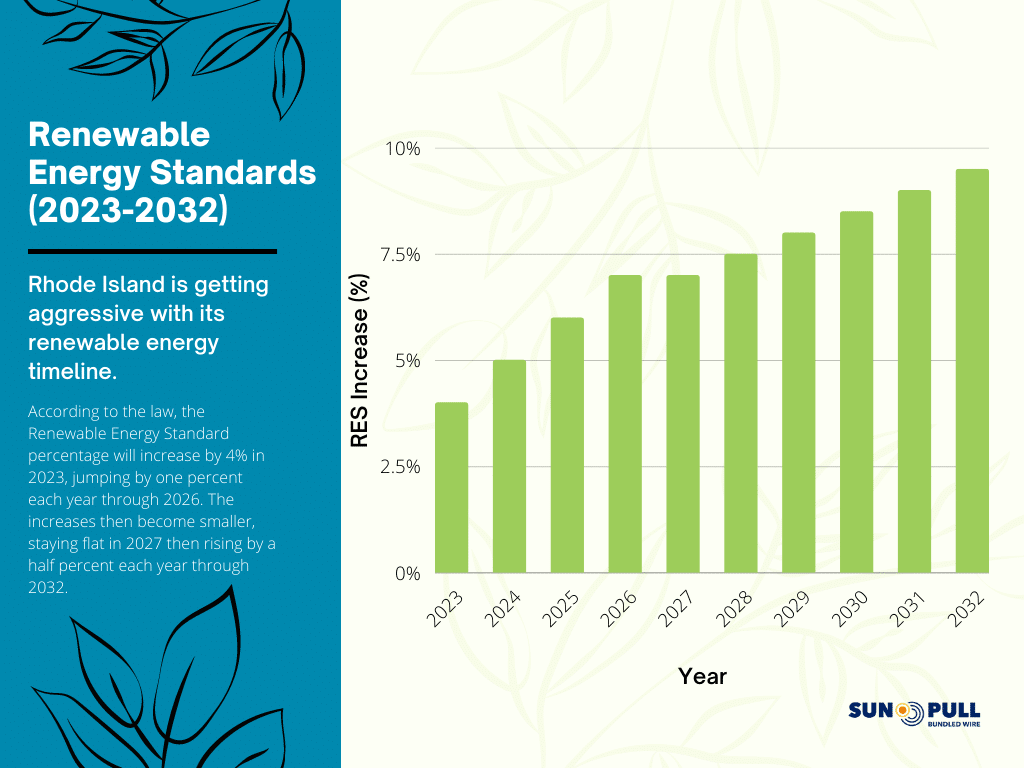
One way to encourage more renewable energy is by turbocharging green initiatives. Under previous state laws on the books, the state was annually increasing the percentage of renewable energy generated by 1.5 percentage points. Under the newly signed law, the number picks up speed each year until reaching a 100% Renewable Energy Standard in 2033. 

 According to the law, the Renewable Energy Standard percentage will increase by 4% in 2023, jumping by one percent annually through 2026. The increases then become smaller, staying flat in 2027 and then rising by a half percent each year through 2032. 

So, how does the new law work? Each year, utilities must buy renewable energy certificates for a certain percentage of power sold annually. These certificates help offset the amount of energy produced and sold by traditional fossil fuels in the state. Besides the certificates, the law also leans on renewable energy producers to up their production using everything from solar energy technologies and offshore wind to hydroelectric facilities and other sources. 

What Does Energy Look Like in Rhode Island Today?  

It might seem like a lofty goal for any state, but Rhode Island has an opportunity to make some waves. 

U.S. Energy Information Administration (EIA) data suggests Rhode Island uses the least energy per capita in the U.S. The state also produces about 90% of its current electric supply using natural gas, the highest percentage in the nation. Only about 12% of the state’s energy came from renewables, with half coming from solar panels. 

While it’s encouraging to see such an aggressive clean energy law on the books, there is certainly work to be done. In March 2022, for example, Rhode Island’s renewable energy production reached about 79k MWh, a far cry from the 478k MWh produced by its natural gas-fired plants. 

The data paints a picture of a state in transition. Renewables aren’t a major energy producer in the state yet, but current production is still four times more than it was in 2018. Rhode Island is also an environmentally conscious state, pumping out the second-lowest CO2 emissions in the nation, only behind Vermont.  

Solar Goals in the U.S.  

Rhode Island is not the first state to push for a 100% renewable future. California was among the first to lean into clean energy, but states on both coasts are now getting involved using the blueprints laid out by early adopters. 

It will take years to wean ourselves from fossil fuels – it also won’t be likely to turn our backs on such efficient forms of energy. Thankfully, renewables are rising in popularity, and their efficiency is expected to increase as innovations are achieved. 

The improvement isn’t hard to see, either. In 2021, renewable energy sources totaled about 20% of U.S. electricity; it could increase due to recent tariff exemptions enacted by the Biden administration. The two-year exemption is expected to keep several upcoming solar projects on track while reducing the number of delays and cancelations over the next 18-24 months. 

Companies like Sun-Pull Wire are also ready to do their part to ensure the solar industry grows as quickly as possible. This means producing solar photovoltaic (PV) bundled wire systems that are easy to install, simple to use, and can be done using fewer workers to address labor shortages or take on even more projects. 

Ultimately, the goal is to make widespread utility-scale solar arrays a possible and affordable option throughout the United States.  

Rhode Island’s Investment in Renewables is Important  

Yes, Rhode Island is a small state, but being successful could prove that fully renewable energy is no longer a pipedream. It’s a tangible goal that can be reached with radical transformation and aggressive building toward the finish line. 

The law is aggressive but also puts Rhode Island on the cutting edge of the renewables curve. Their commitment to green energy is launching it ahead of other states like California, New York, and North Carolina. 

It should come without saying that the solar industry is excited to see what a renewable future looks like. We’re ready for whatever might come next and excited to help serve everyone’s solar needs today, tomorrow, and for years to come!

What is Renewable Energy? How Does It Work?

Renewable energy is becoming a big business.

According to the United States Energy Information Administration (EIA), Americans used nearly 4 trillion kilowatt-hours (kWh) in 2021. From computers and televisions to machines and heating/cooling systems, businesses and homes heavily rely on electrical power.

The lion’s share of our electricity comes from burning fossil fuels like petroleum and natural gas. These two sources alone made up about 69% of all U.S. energy consumption in 2020. Other energy sources, like coal, have seen their use begin to scale back for cleaner options like wind and solar.

Emissions and greenhouse gases produced by traditional fossil fuel burning are associated with negative impacts, including smog, environmental issues, and health problems. As a result, organizations like the Global Commission on the Economy and Climate have suggested the world cut back on emissions by 2030 or risk losing its grip on global warming.

The rise of clean energy has been happening for decades, taking on greater importance as an affordable, cleaner, and sustainable form of energy compared to finite fuels like coal and petroleum. As companies continue refining alternative energy production techniques, more renewable energy sources will come online, reducing our reliance on traditional sources.

What Are Renewables?

Renewable energy has been around for many years, starting thousands of years ago with the use of wood. However, other modern renewable fuels have found their footing in more recent years.

In the middle of the Second Industrial Revolution in the United States, renewable fuels became more available, beginning in 1880 with the first hydropower electric plant in Grand Rapids, Michigan. Since then, renewable energy sources have improved with increased research development and application.

Today, renewable energy includes everything from biomass and water to wind, solar, and geothermal options, accounting for about 20% of electricity generated in the U.S. in 2021. The percentage will likely keep growing while we look for better and more sustainable ways to produce electricity without relying so deeply on finite fossil fuels.

For now, America has several excellent renewable energy options to help it cut emissions and maintain current power generation levels.

Biomass

Biomass energy comes from plant and animal matter – everything from wood and agricultural feedstock to manure, sewage, and even biogases captured at dairy farms and landfills.

Wood, by far, was America’s largest energy supplier through much of the 1800s. In more recent years, we’ve been able to create a lot more electricity from biomass, including capturing biomethane to use as renewable natural gas. Ethanol, another type of biomass fuel, is used in gasoline. Fatty acid methyl esters (FAME) help make biodiesel.

Biomass options aren’t as efficient as traditional fossil fuels, and they aren’t as clean as wind or solar energy. Still, they provide a renewable option that reduces reliance on traditional methods. There is no shortage of garbage, plant, and animal waste, meaning biomass is an ultimately renewable resource that could improve our environment.

Hydropower

Hydropower uses the natural movement of flowing water to create electricity for use.

Water falls into a dam’s penstock pipes and goes through a turbine. As the water moves through the turbine, it spins, sending energy to a generator that produces kinetic energy that gets converted into electricity. Facilities rely on the constant flow of water through these systems to create electricity 24/7 and can pump water back into the reservoir to recycle it during peak hours.

Ultimately, water is a renewable resource that can meet increased short-term demand quickly and doesn’t use or destroy any materials to create power. On the downside, dams can alter the environment and change the natural flow of rivers, are expensive to set up, and are somewhat beholden to the weather for their production.

Geothermal

Geothermal electricity uses the power of steam created from underground reservoirs to turn a turbine. Like hydropower, the turbine connects to a generator that produces electricity for use.

An energy company will drill into hot spots under the Earth’s surface, then pump water through the installed pipes back into the facility. Once in the facility, the hot water turns into steam with enough power to turn a turbine. This process occurs 24/7/365 and is generally predictable and easy to plan. Many geothermal plants also use a closed-loop system that allows water to be pumped back into the ground to keep the process going.

Geothermal energy is an eco-friendly option when managed correctly. Luckily, the Earth is constantly generating heat, so as long as non-potable water is added to replace what’s lost to steam, it’s possible to keep the plant going. On the downside, plants are expensive to establish and can cause earthquakes due to drilling. Plant locations may also have higher earthquake frequencies, but moving the plant further away from fault lines can reduce the risk.

Wind Power

Wind energy involves gigantic turbines placed in areas where the wind blows frequently. As the wind blows, blades attached to an electric generator spin, converting kinetic energy into electricity.

Environmentally friendly wind turbines generate electricity from an ultimately renewable resource, provided the wind blows. It’s also a low-cost and space-conscious way of producing energy that has the potential to grow in areas where the likelihood of wind blowing is high.

However, the turbines are tall, create some noise, and can turn off some people who want a wide-open view of the countryside. They also pose a risk to birds and bats that may get hit by the blades as they spin and could impact habitats if they’re carelessly site planned.

Solar Power

Solar energy technologies have come a long way in a short amount of time, allowing them to expand across the United States. Photovoltaic (PV) panels convert sunlight into usable electricity through PV cells by exciting electrons. The movement in the electrons creates direct current (DC) electricity which is sent to an inverter through specialized PV wires designed to withstand outdoor conditions. The inverter converts the DC electricity into alternating current (AC) power, then sends it to the grid.

Although concentrated solar arrays can be expensive to establish, they have a low cost to maintain once completed. Solar may also be capable of powering the entire country with some strategic panel placement. According to the Office of Energy Efficiency and Renewable Energy, it would only take about 22,000 square miles of land to power the entire country. Technology is constantly improving, so that number may drop further as more efficient panels and delivery methods come online.

Solar arrays can take up a lot of space but typically pop up in areas where development or farming aren’t feasible. These locations get exposed to a lot of sunlight, allowing the panels to collect solar radiation even on cloudy days.

There is also the potential to produce even more electricity through bifacial solar cells. These panels collect sunlight on both sides, making them more attractive in areas where snow or other materials can bounce radiation onto their undersides.

Why Renewable Energy Makes Sense

Renewables will take on a more critical role in our energy plans in the coming years.

Fossil fuels may be efficient energy producers, but they’re a finite resource. They also tend to be dirtier forms of energy production when compared to renewables like solar, wind, and water. As the world works toward reducing its reliance on fossil fuels, renewables will need to pick up the slack to maintain the same level of production.

However, the push for more renewable energy also coincides with the United States’ goal of producing 100% carbon pollution-free energy by 2035. Outside of simply being cleaner, renewable energy sources like solar and wind are less expensive to support and maintain over time, more economical energy producers, and will become more affordable over the years. From a safety and security standpoint, renewables can create a network of decentralized microgrids that may reduce the chances of a mass blackout during a natural disaster or a terrorist attack.

The U.S. is already working toward its 2035 goal. In 2021, about 23.6 gigawatts worth of solar energy were installed, totaling 121.4 gigawatts – enough electricity to power more than 23 million homes.

The Future of Renewable Energy

We’re starting to pull away from fossil fuels, but they are still an integral part of the current energy landscape and likely will be for a while.

Renewables are showing sustained growth, with solar comprising nearly 4% of all U.S. electricity produced. Installations are moving more quickly, and advancements in solar technology, down to the PV wire used to connect the panels to the combiner, or junction, box.

Sure, there is still a lot of work to do to get solar, wind, and other renewables to the level fossil fuels have been at for years. But it comes with the success of knowing the electricity generated is cleaner, more affordable, and nearly infinite.